

Franco Colapinto’s F1 journey has been full of promise, setbacks and controversy, but after a stronger 2026 season and a 2027 renewal with Alpine, the question remains: has he done enough to prove he belongs in Formula 1?
Franco Colapinto's Formula 1 career has been anything but straightforward.
The Argentine arrived in F1 midway through the 2024 season with Williams, impressed almost immediately, lost his seat despite that promising debut, joined Alpine as a reserve driver, replaced Jack Doohan in 2025 and then earned a full-time seat for 2026.
Now, after a much-improved 2026 campaign, Alpine have confirmed that Colapinto will remain with the team for 2027.
But following his costly crash at the Azerbaijan Grand Prix, one question is still worth asking: has Colapinto actually done enough to prove that he deserves to be in Formula 1?
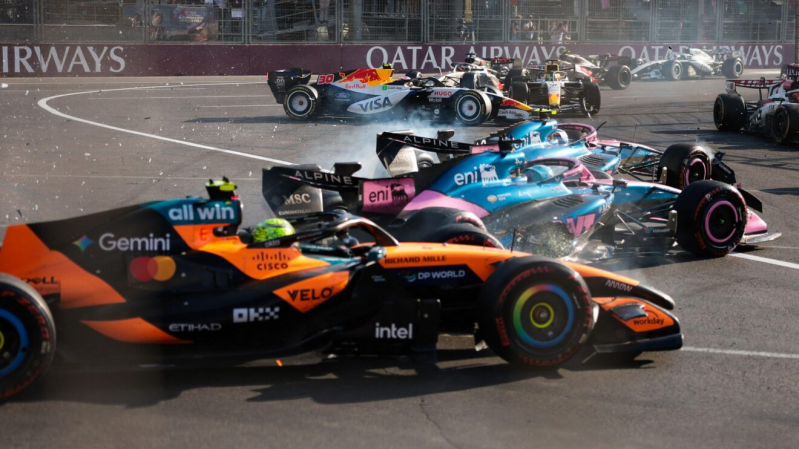
Franco Colapinto, Alpine, Lando Norris, McLaren, Pierre Gasly, Alpine
From F2 to the F1 grid
Colapinto's F1 opportunity came rather suddenly.
After competing in Formula 2, Williams promoted him to replace Logan Sargeant from the 2024 Italian Grand Prix onwards. He immediately showed that he wasn't simply there to make up the numbers.
Across his nine-race stint, Colapinto scored points on multiple occasions, including a remarkable eighth-place finish at Monza on his F1 debut and a sixth-place finish in Azerbaijan.
Those performances created a problem for Williams.
Carlos Sainz was signed for 2025, while Alex Albon already had a contract, leaving Colapinto without a full-time seat despite showing encouraging pace.
Instead of disappearing from the F1 paddock, however, Colapinto moved to Alpine as a reserve driver.
And he wouldn't have to wait long for another opportunity.
Alpine gave Colapinto another chance
When Jack Doohan's time with Alpine ended after the Miami Grand Prix in 2025, Colapinto was given the opportunity to race alongside Pierre Gasly.
It wasn't an easy start.
Alpine were struggling for performance and Colapinto failed to score a point during his 2025 campaign. There were flashes of speed, but also mistakes and inconsistency.
That made his position heading into 2026 rather interesting.
Was he genuinely an F1-calibre driver, or had his impressive Williams debut been a short-lived honeymoon period?
Alpine ultimately decided to find out.
Colapinto was retained for 2026 — and this season has provided a much clearer picture of what he can offer.
2026 has been a different Colapinto
The biggest argument in Colapinto's favour is simple: he has improved.
Alpine's car has been much more competitive in 2026, but Colapinto has also been more consistent and closer to Gasly.
Before his 2027 extension was announced, Alpine managing director Steve Nielsen acknowledged that Colapinto had improved significantly, highlighting performances in China and Miami and saying he was getting closer to Gasly.
The numbers back up the improvement.
As of the current F1 statistics, Colapinto has scored 27 points in 2026, putting him 12th in the Drivers' Championship. His best F1 result remains sixth, which he has achieved once.
That isn't the record of a driver dominating the midfield, but it is a considerable improvement on his point-less 2025 season.
And importantly, Alpine noticed it.
Why Alpine re-signed him for 2027
On August 27, Alpine officially confirmed that Colapinto would remain alongside Pierre Gasly for 2027.
Flavio Briatore said that Colapinto had "truly grown and matured" during 2026 and specifically pointed to his performances in Miami and Montreal.
The Montreal race is particularly significant.
Colapinto achieved a career-best sixth place, giving Alpine valuable points and demonstrating that he could capitalise when the opportunity presented itself.
There is also another factor that shouldn't be ignored: stability.
Alpine are still rebuilding. Keeping the same driver pairing gives the team continuity while it concentrates on improving its car.
Colapinto also brings considerable support from Argentina and across South America, something that has commercial value for Alpine. Formula1.com's analysis of his renewal noted both his growing fanbase and sponsorship appeal as factors in the overall package Alpine considered.
But the team has been clear that his renewal wasn't simply about commercial value. His improvement on track was central to the decision.
Then came Baku
And this is where the debate becomes more complicated.
The 2026 Azerbaijan Grand Prix should have been an opportunity for Alpine to score heavily.
Colapinto qualified ninth, directly behind Gasly in seventh. Both cars were running inside the points when a late Safety Car created another opportunity.
Instead, disaster struck.
At the restart, Colapinto locked up heading into Turn 1 and collided with his own teammate, Gasly. The incident also eliminated Lando Norris.
All three drivers retired.
Alpine had been on course for a double-points finish. Instead, both cars were out.
Colapinto subsequently apologised to Gasly and the entire Alpine team, accepting responsibility for the incident.
The official result lists both Colapinto and Gasly as DNFs.
It was an extremely costly mistake.
And because Colapinto had already been given his 2027 contract, the timing makes the incident even more interesting.
Does the Baku crash change anything?
Probably not when it comes to 2027.
Alpine made their decision before Baku, based on a much larger sample of races and the progress Colapinto had made throughout the season.
One mistake doesn't erase an improved season.
But that doesn't mean the crash should simply be ignored.
Formula 1 is an unforgiving sport, and Colapinto's career so far has followed a familiar pattern: huge potential mixed with moments of unnecessary risk.
His Williams performances demonstrated his speed.
His 2025 Alpine campaign demonstrated that speed alone wasn't enough.
His 2026 season has shown greater consistency and maturity.
Baku, however, was a reminder that there is still another step for him to take.
So, does Colapinto deserve to be in F1?
There are two sides to the argument.
The case for Colapinto is that he has demonstrated genuine F1 pace, scored points in an increasingly competitive Alpine, improved his consistency and earned the confidence of the team management.
He also has something extremely valuable for a young driver: room to improve.
The case against him is that he still hasn't converted his potential into a truly outstanding F1 record.
He has 40 Grand Prix entries, 32 career points and no podiums, with a career-best sixth place.
Those numbers aren't enough to place him among F1's proven front-runners.
But that isn't necessarily the standard Alpine are applying.
Their immediate objective is to build a faster car and move further up the grid. For that, they appear to believe Gasly and Colapinto provide the consistency and continuity they need.
And now Colapinto has another year to prove them right.
2027: The real test begins
The irony of Colapinto's 2027 renewal is that it doesn't necessarily remove the pressure.
It changes it.
He no longer needs to fight simply to remain on the F1 grid. Instead, he needs to demonstrate that he can become an important part of Alpine's future.
The question isn't just "Does Franco Colapinto deserve an F1 seat?"
It's becoming:
"Can Franco Colapinto become the driver Alpine believes he can be?"
His 2026 season suggests there is a foundation to build on.
His Baku crash shows there is still work to do.
And with Alpine committing to him for 2027, we are going to get the chance to find out.
For Colapinto, the next season could be the most important of his career so far.
The opportunity is there. Now the results have to follow.
Add comment
Comments